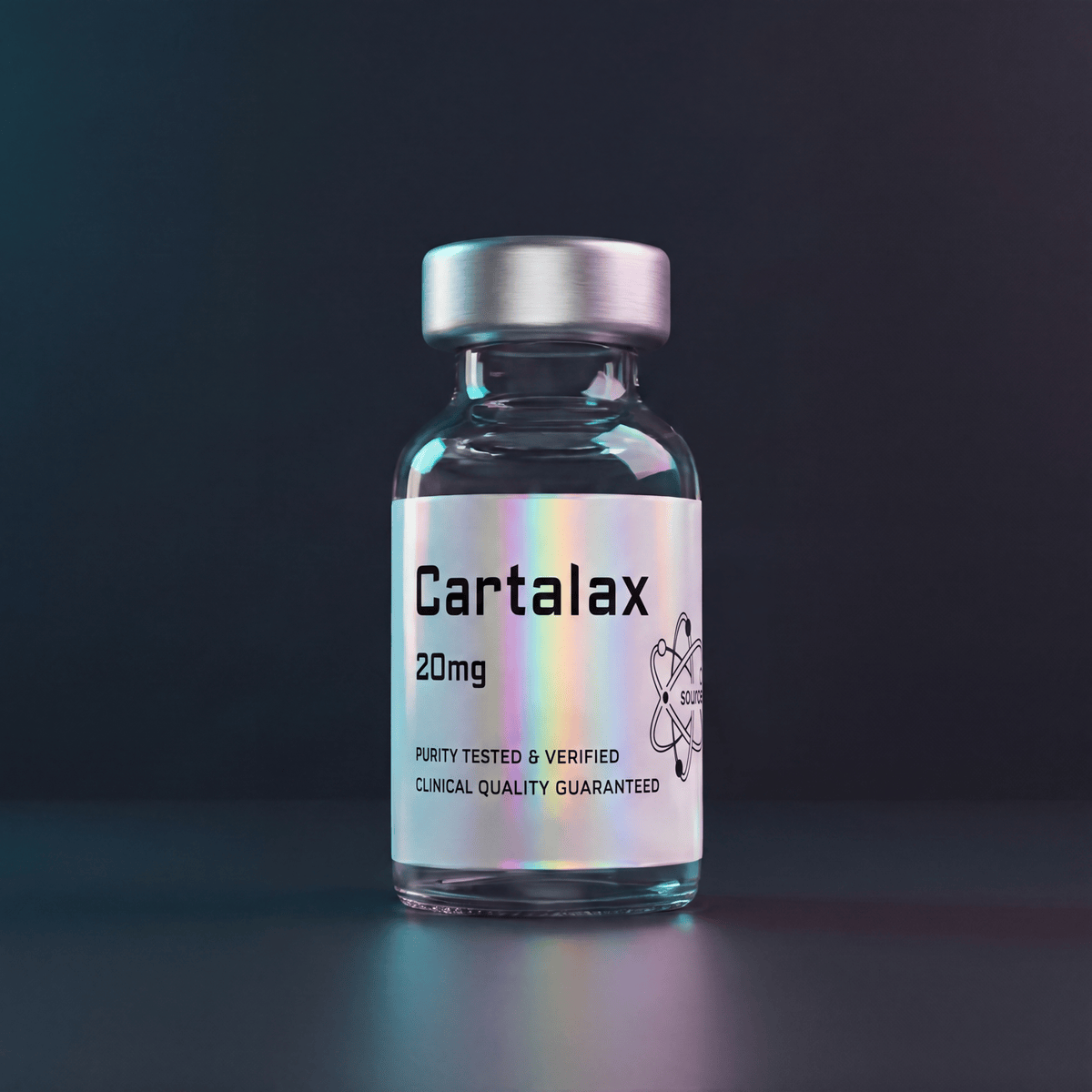
Cartilage "Maxxing"
Cartilage has a reputation for being a one-way street. Once it's gone, it's gone. Wear it down and your only options are management, cortisone, and eventually a titanium replacement. That's the conventional story. And a class of peptides developed quietly behind the Iron Curtain of the Soviet Union once again suggests it's incomplete.
One compound keeps surfacing in any serious conversation about joint longevity, and it has been sitting in the Russian research literature for decades: Cartalax. The mechanism is genuinely different from the typical BPC-157 / TB-500 advice most people already know.
What Cartalax Actually Is
Cartalax is a tripeptide — three amino acids linked together (alanine, glutamic acid, asparagine). Think of amino acids as individual links in a protein chain. Three links makes an extremely short, extremely targeted chain.
Its lineage traces back to the Russian bioregulator program — decades of Soviet and post-Soviet research into short, tissue-specific peptide signals, the kind of work that happened almost entirely outside the Western scientific conversation. Cartalax isn't a "peptide" in the way most people use the word. It's a bioregulator.
That distinction matters. Most peptides you hear about work systemically — they circulate, hit receptors, trigger a response. A bioregulator is a narrower subset: short enough and tissue-targeted enough that it's thought to act directly at the level of gene expression inside specific cell types. Same peptide chemistry. A much more specific address on the envelope.
For your science nerds out there: the model is that these short peptides act as gene expression modulators. They're thought to interact with DNA and chromatin in specific tissues to turn cellular programs up or down at the transcription level. In plain terms — they may remind certain cells what they're supposed to be doing.
For Cartalax, the target tissue is cartilage. The cells are chondrocytes — the specialized cells that build and maintain the cartilage matrix cushioning your joints.
Something to Let the Mind Marinate On
As we age, chondrocyte activity doesn't just get damaged. It goes quiet.
These cells start producing less collagen type II — the main structural protein in cartilage. Less aggrecan — the proteoglycan that lets cartilage hold water and absorb shock. And they stop responding to the repair signals the body is still sending.
At the same time, the enzymes that break cartilage down get louder. The research points specifically at the matrix metalloproteinases — MMP-1 and MMP-13 — the enzymes that literally chew up collagen and matrix. So you get a double problem: less building, more demolition.
What the available research on Cartalax suggests is that the peptide pushes on both ends of that equation — upregulating the cartilage-synthesis genes (collagen, aggrecan) while downregulating those MMP demolition enzymes and quieting the inflammatory signaling that drives them. Less like adding fuel to the fire, more like pressing reset on a machine that's been idling in standby.
And the short chain length isn't a weakness — it's the point. A tripeptide can slip into the cell and interact with nuclear structures that larger molecules can't reach. That's what makes it mechanistically distinct from a broad anti-inflammatory, a collagen supplement, or even the tissue-repair peptides most people already stack.
The Russian Protocol
The protocol that surfaces repeatedly in the Russian observational literature is a short, intensive cycle: roughly 10mg per day for 10 consecutive days, repeated every few months rather than run continuously. That "pulse it, then step away" structure is characteristic of how the bioregulators were studied across the board — short bursts of signal, not a permanent drip.
Full transparency: this is the only protocol Dr. Jon has personally run himself, and it worked for him. There are other dosing approaches floating around out there — but they're untested by us. We're only going to vouch for what's actually been done. Your results depend on your body, your baseline, and how the rest of your foundation is built — which is exactly why the next step isn't "copy the cycle." It's a conversation, built around you.
The Honest Part Most Sellers Skip
There are zero registered clinical trials on Cartalax. No FDA or EMA approval. The human data is Russian observational work with all the limitations that carries — and placebo effects are enormous in anything measuring pain and mobility.
There's also a real mechanistic caveat worth sitting with. Part of Cartalax's proposed longevity angle is that it appears to modulate cellular senescence markers — p16, p21, p53. That sounds great, until you remember those same proteins are tumor suppressors. Turning them down for joint repair is exactly the kind of off-target question that doesn't have a long-term human answer yet.
That's not a reason to be scared of the compound. It's a reason to be an adult about it: this is genuinely experimental, it belongs in an informed n=1 framework, and it belongs on top of a foundation — movement, inflammation, metabolic health — not instead of one.
What This Actually Means
Most people approach joints the same way: wait for pain, then look for something to quiet it down.
The bioregulator framework asks a different question — why did this tissue stop maintaining itself in the first place? If chondrocytes are suppressed rather than destroyed, there may be a real window, especially earlier in the process, where restoring the signal matters. The question shifts from "how do I manage symptoms?" to "what went quiet, and can we turn it back on?"
This content does not constitute medical advice, and is for educational purposes only.