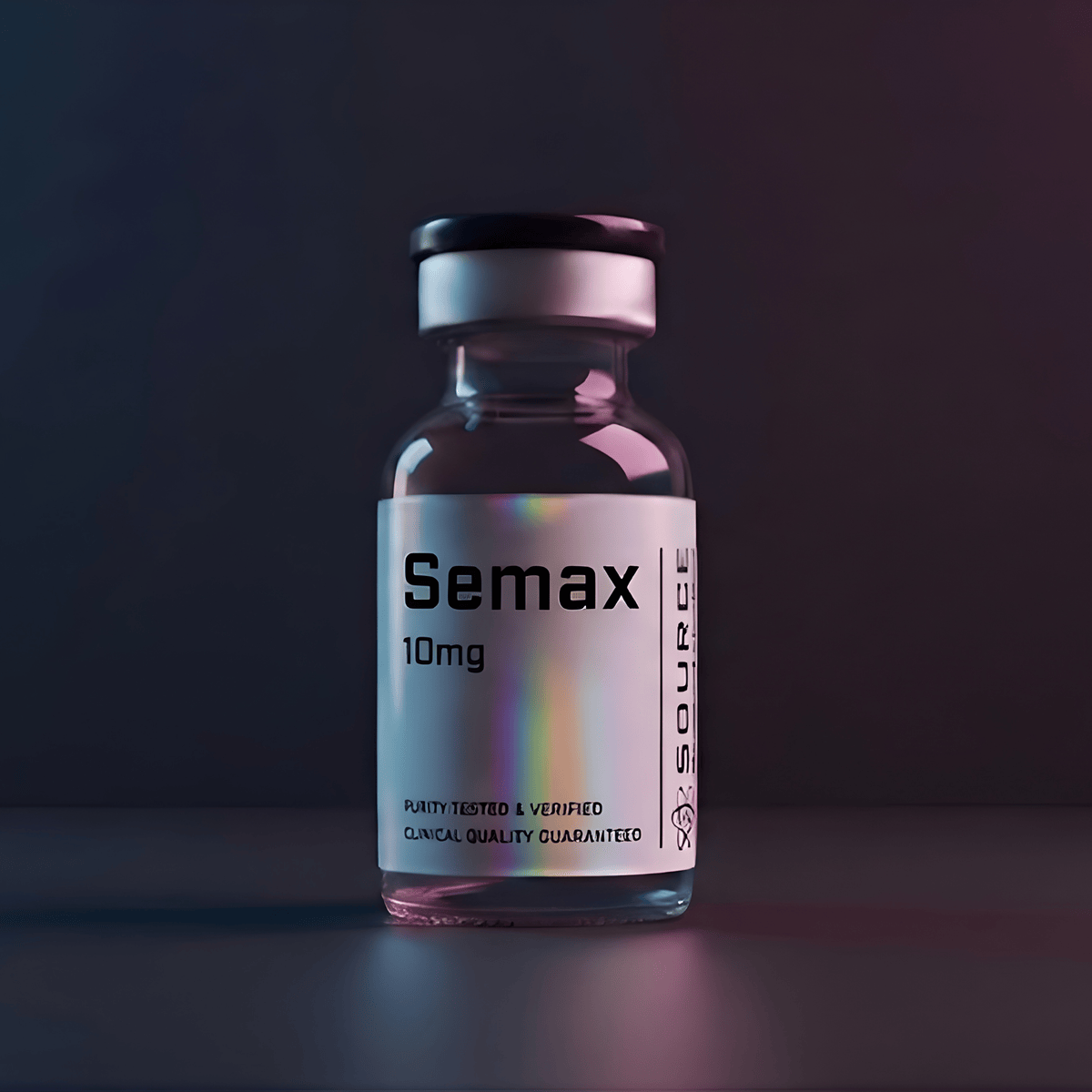
Semax: The Brain Chemical Your Doctor Didn't Pay Enough Attention to in Med School
Your brain has a built-in emergency repair system, and most people have no idea it exists until something's already broken. Turns out, a small fragment of a stress hormone might be the key to switching it on intentionally.
The Science
Semax is a synthetic peptide derived from a portion of ACTH — adrenocorticotropic hormone, the molecule your body fires off when it's under threat or serious demand. In the 1980s, researchers started noticing something that didn't fit the expected picture: certain fragments of ACTH were influencing brain performance in ways that had nothing to do with the stress response itself. They weren't triggering cortisol. They were doing something else entirely. Semax is a stabilized, modified version of one of those fragments — developed initially in Russia and studied extensively over the decades that followed, primarily around neurological applications.
The mechanism that pulled the most research attention involves BDNF — Brain-Derived Neurotrophic Factor. For your science nerds out there: think of BDNF as fertilizer for your neurons. It supports the survival of existing brain cells, promotes new neural connections, and sits at the center of neuroplasticity — the brain's ability to reorganize and adapt. Low BDNF is associated with cognitive decline, poor mood regulation, and a reduced capacity for learning and memory consolidation. Semax appears to upregulate BDNF and the signaling pathways around it. That's the core of why this compound attracted serious scientific interest.
Here's the kicker — Semax also appears to interact with the dopaminergic and serotonergic systems. And it's worth being clear about what that actually means, because these aren't just "feel good" chemicals. Dopamine and serotonin govern focus, motivation, working memory, and the brain's ability to filter signal from noise. There's also research suggesting Semax modulates gene expression involved in the brain's immune response — particularly in the context of ischemia, which is oxygen deprivation — which is why much of the early clinical research centered on stroke recovery and neuroprotection.
What makes Semax structurally interesting is its stability. Natural ACTH fragments break down in the body within minutes. Semax was engineered with a modified amino acid sequence that resists that enzymatic breakdown — meaning it actually survives long enough to reach its targets. It's typically administered intranasally, which allows it to cross the blood-brain barrier — the protective membrane that keeps most compounds out of the brain — more efficiently than many substances that have to be injected or processed through the gut first.
The Practical Takeaway
Most conversations around cognitive performance go straight to stimulants — caffeine, racetams, nootropic stacks that just push the brain harder. What the Semax research points toward is a fundamentally different model. Rather than forcing output, the question being asked is: what does the underlying infrastructure actually look like? And can we improve it?
That distinction matters a lot. If nothing changes structurally, nothing changes functionally. BDNF levels aren't fixed. They respond to exercise, sleep, and nutrition. They also appear to respond to compounds that interact directly with those signaling pathways. That's the entire picture researchers have been trying to understand — not just what the brain produces on the surface, but what the maintenance environment underneath looks like.
The foundation has to be there first. Semax isn't a shortcut around a broken system. These are signals, not solutions. But if you're already doing the work and want to understand what trophic support — the baseline maintenance signaling that keeps neurons functioning — actually contributes to cognitive performance, this is one of the more interesting threads in the research literature right now.
This content does not constitute medical advice, and is for educational purposes only.