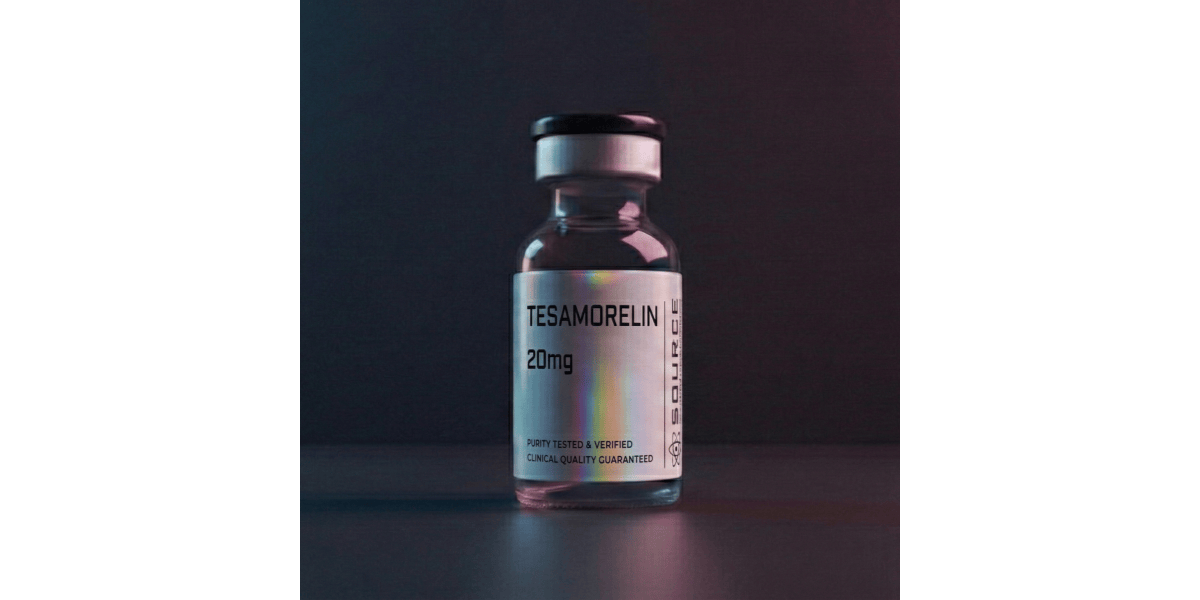
Independently Purity Tested
- Batch
- TE10-0711
- Measured mass
- 11.10 mg / 10mg
- Tested
- July 2026
Independently tested by Janoshik Analytical, a third-party laboratory unaffiliated with Source BioLab. Full report on file.
View CertificateAbout this Product
Tesamorelin is a synthetic analogue of human growth hormone-releasing hormone (GHRH), the hypothalamic peptide that governs pituitary growth hormone secretion. It was developed under the code TH9507 by Theratechnologies Inc. of Montreal, Canada. Native GHRH circulates only minutes because dipeptidyl peptidase-4 cleaves its N-terminus; the design blocked that cleavage without altering the receptor-binding sequence, giving a molecule stable enough for once-daily subcutaneous administration. It was marketed as EGRIFTA. Tesamorelin retains the complete 44-amino-acid sequence of human GHRH(1-44) and adds a trans-3-hexenoyl group to the N-terminal tyrosine: trans-3-hexenoyl-Tyr-Ala-Asp-Ala-Ile-Phe-Thr-Asn-Ser-Tyr-Arg-Lys-Val-Leu-Gly-Gln-Leu-Ser-Ala-Arg-Lys-Leu-Leu-Gln-Asp-Ile-Met-Ser-Arg-Gln-Gln-Gly-Glu-Ser-Asn-Gln-Glu-Arg-Gly-Ala-Arg-Ala-Arg-Leu-NH2, with an amidated C-terminus. The molecular formula is C221H366N72O67S, the molecular weight about 5135.9 g/mol, and the CAS number 218949-48-5. Tesamorelin is an agonist at the GHRH receptor, a Gs-coupled receptor on pituitary somatotrophs. Binding elevates intracellular cyclic AMP and stimulates pulsatile release of endogenous growth hormone, which drives hepatic production of insulin-like growth factor 1 (IGF-1). Because it acts upstream at the pituitary rather than supplying exogenous growth hormone, secretion stays subject to somatostatin and IGF-1 feedback. Reported elimination half-life after subcutaneous dosing is about 26 minutes. The pivotal Phase 3 trial reported by Falutz et al. in the New England Journal of Medicine (2007;357:2359-2366) randomized 412 patients with HIV infection and excess abdominal fat 2:1 to 2 mg tesamorelin subcutaneously once daily or placebo for 26 weeks; visceral adipose tissue measured by computed tomography fell 15.2 percent in the tesamorelin arm and rose 5.0 percent under placebo. A second identically designed Phase 3 trial replicated the result, and a pooled analysis with open-label extension data (Falutz et al., Journal of Acquired Immune Deficiency Syndromes, 2010;53:311-322) covered 806 participants. On November 10, 2010 the U.S. Food and Drug Administration approved tesamorelin as EGRIFTA, sponsored by Theratechnologies, for the reduction of excess visceral abdominal fat in HIV-infected patients with lipodystrophy, the first agent approved for that indication; reformulations followed as EGRIFTA SV in 2019 and EGRIFTA WR in 2025. The labelling is confined to HIV-associated lipodystrophy and does not extend to weight reduction or obesity. Tesamorelin differs from the secretagogues it is grouped with. Sermorelin is only the first 29 residues of GHRH and is cleared quickly; CJC-1295 is a modified GHRH fragment engineered for prolonged circulation. Ghrelin mimetics such as ipamorelin and GHRP-6 are not GHRH analogues and act at the growth hormone secretagogue receptor GHS-R1a. Preserving the entire native 44-residue sequence while adding protease resistance keeps tesamorelin in use as a tool for probing the growth hormone axis in metabolic disease. A randomized, double-blind, multicenter trial reported by Stanley et al. in Lancet HIV (2019) evaluated it over 12 months in 61 people with HIV and non-alcoholic fatty liver disease, with biopsy-based assessment of hepatic fat and fibrosis progression. For research use only. Not for human consumption.
Tesamorelin Profile
- Chemical Type
- Synthetic GHRH analog
- Molecular Weight
- 5136 g/mol
- CAS Number
- 218949-48-5
- PubChem CID
- 16137828
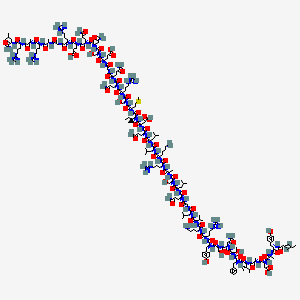
Tesamorelin Structure
- CAS Number
- 218949-48-5
- Molecular Formula
- C221H366N72O67S
- Molecular Weight
- 5136 g/mol
- PubChem CID
- 16137828
Structure and chemical registry data from PubChem, the NIH's public chemistry database.
Customer Reviews
No reviews for this product yet.