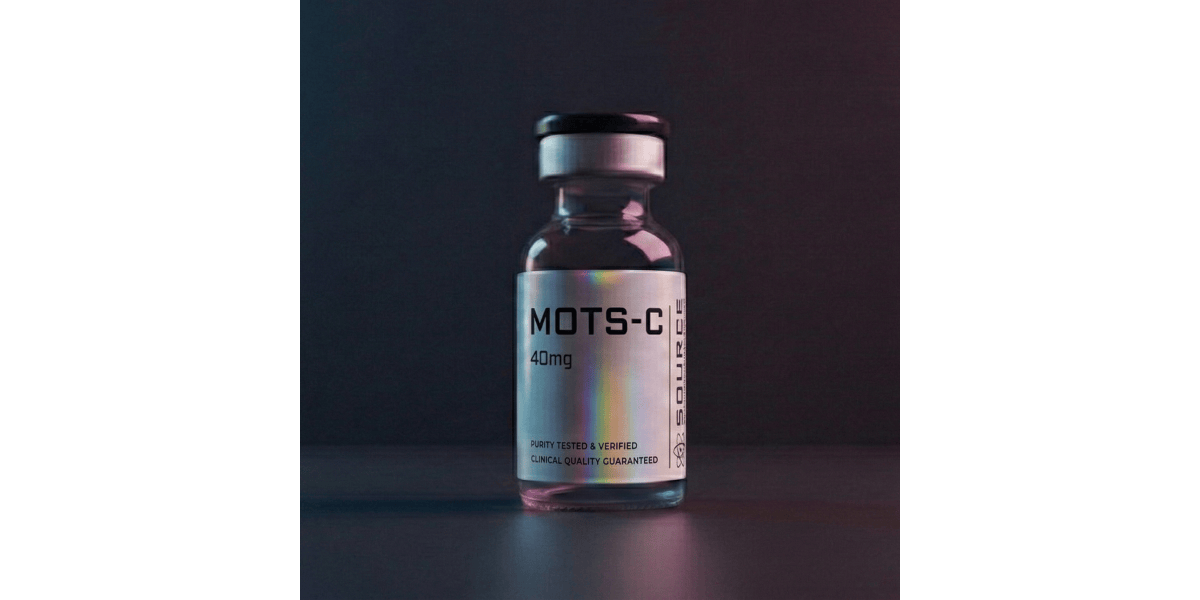
MOTS-c: The Mitochondrial Signal — Mechanism, Evidence, and Where It Fits
Most peptides your body makes are written in nuclear DNA — the genome everyone learned about in high school biology. MOTS-c isn't. It's written inside your mitochondria, in the small, ancient genome those organelles carry on their own. And the fact that it exists at all has forced researchers to rethink what mitochondria actually are.
You've heard mitochondria called the powerhouse of the cell. That's not wrong — but it's wildly incomplete. Mitochondria don't just generate power. They talk. MOTS-c is one of the ways they do it, and understanding what it's saying is the difference between using it well and wasting it.
This is the long version. If you read the SS-31 article first, you'll see the two halves of one story: SS-31 works on the structure of the mitochondria. MOTS-c works on the signal.
What MOTS-c Actually Is
MOTS-c — mitochondrial open reading frame of the 12S rRNA type-c — is a 16-amino-acid peptide first identified in 2015. It's encoded by a short open reading frame tucked inside the mitochondrial 12S ribosomal RNA gene, which is exactly the kind of place nobody expected to find a functional protein. Mitochondrial DNA was supposed to code for a handful of respiratory-chain subunits and the machinery to build them. Not signaling molecules.
That's what makes it strange, and that's what makes it interesting. MOTS-c is encoded in the mitochondrial genome but translated out in the cell's cytoplasm, and from there it does two jobs. Locally, it acts inside the cell that made it. Systemically, it circulates in the bloodstream and acts on distant tissues like a hormone. Researchers coined a word for molecules that do both: mitokine (a mitochondria-derived signal that influences cells throughout the body).
For the chemistry-minded: the sequence is MRWQEMGYIFYPRKLR, molecular formula C101H152N28O22S2, molecular weight 2,174.6 g/mol, CAS 1627580-64-6. Clinical-grade MOTS-c at Source BioLab is that molecule — nothing added, nothing modified.
Structure and Signal
When cells face metabolic stress, physical demand, or pressure to repair, MOTS-c gets released and travels to the nucleus, where it starts influencing how genes related to energy management and stress response are expressed. Think of it less like a hormone and more like a distress flare. Your mitochondria are telling the rest of the cell: conditions are changing, and we need to adapt.
The established story on MOTS-c has centered on AMPK activation. AMPK is generally well known, but if not, here's the quick version: it's your cells' metabolic master switch. Flip it on and cells get better at pulling in glucose, burning fat, and managing energy under load. That's the mechanism that earned MOTS-c the "exercise mimetic" label in the early literature, and it's well-documented. It isn't in question.
In 2026 the research handed us three more pathways, and they're genuinely interesting.
Four Pathways, Not Just AMPK
Research published in 2026 makes clear that AMPK is only part of it. Taken together, the studies describe MOTS-c operating across at least four distinct pathways — the classic one, and three more.
First, inflammation. MOTS-c drops two of the cytokines (the chemical messengers that drive tissue-level inflammation) — IL-1β and IL-6. Less of that signal, less of the low-grade fire that ages tissue.
Second, structure. It suppresses mitochondrial fragmentation (healthy mitochondria breaking into pieces that can't do their job) by reducing the fission proteins Drp1 and Fis1. Your energy factories stay intact under stress instead of splintering.
Third, cleanup. It stabilizes lysosomal membranes. Lysosomes (your cells' waste-processing centers) break down damaged proteins and clear out cellular debris — the ongoing cleanup operation that keeps cells functional. Under oxygen deprivation or prolonged stress, lysosomal membranes can rupture and spill their contents into the cell. When that happens, you get an inflammatory cascade and a form of programmed cell death that accelerates tissue damage. MOTS-c appears to protect that infrastructure before it fails.
That third one is the newest, and it touches something central to aging.
A 2026 study in Autophagy (Shi et al., DOI 10.1080/15548627.2026.2677180) looked at exactly this in ischemic (blood-starved) tissue — a soft-tissue transplant model where blood supply is the limiting factor. MOTS-c reduced endothelial pyroptosis (an inflammatory form of cell death in the blood-vessel lining) and lysosomal membrane permeabilization (the leak that precedes rupture), working through a pathway the authors labeled PLA2G4A–LMP, with MAPK and NF-κB signaling upstream. The net effect was restoration of cellular homeostasis (a stable, working balance) at the mitochondria–lysosome interface. In plain terms: MOTS-c appears to interrupt the signaling chain that leads to lysosomal rupture, protecting the cleanup infrastructure before it breaks.
This connects directly to one of the central problems in aging biology. At the core of cellular aging is the gradual failure of the systems that clear damaged proteins and dysfunctional organelles. When that clearing capacity degrades, cellular health degrades with it. A compound that appears to stabilize that infrastructure under stress is touching something meaningful.
The Anti-Fibrotic Signal
Separate research has documented a consistent anti-fibrotic effect, and it showed up in two very different tissues in the same year.
The first was cardiac. A 2026 study in Biomedicines (Liao et al., DOI 10.3390/biomedicines14051048) combined human tissue, a mouse model, and cell work to look at MOTS-c in atrial fibrillation. In human atrial tissue from AF patients, MOTS-c expression was significantly reduced, and tissue levels tracked inversely with how much fibrosis was present. Plasma MOTS-c was lower in AF patients too, and inversely correlated with NT-proBNP (a validated blood marker of cardiac stress). In the mouse model, MOTS-c treatment reduced AF inducibility and cut angiotensin-II-driven (the hormone signal that drives blood-pressure-related heart strain) atrial fibrosis and hypertrophy (scarring and thickening). And in isolated fibroblasts (the cells that lay down scar tissue), MOTS-c directly inhibited activation, proliferation, and migration.
The second was the ischemic-tissue study above, where MOTS-c modulated collagen remodeling in the same direction.
Two contexts, same directional result. And the reason that matters isn't just the heart. The heart fibroses. So do the liver, kidneys, lungs, and skeletal muscle. A compound signaling fibroblasts to stand down consistently across tissue types is touching a mechanism that runs through nearly every age-related organ decline we care about.
Read that again. Imagine playing with a switch that's tied to every single organ's age-related decline — and modifying it. Yeah. Might be worth a shot, unless you're ready for the dirt nap early.
What the Human Data Says — and Doesn't
Here's where it's worth slowing down, because the hype around MOTS-c runs well ahead of the evidence, and the evidence is genuinely interesting on its own.
Almost everything above is preclinical: rodent models, cell lines, tissue samples. The human data on MOTS-c is observational, and it's about endogenous MOTS-c — the amount your own body makes — not about what happens when you administer it.
That observational data is telling a consistent story, though. A 2026 cross-sectional (single point in time, no follow-up) study (Peng et al., Biomedicines, DOI 10.3390/biomedicines14040918) measured MOTS-c in 72 heart-attack patients undergoing stent placement. Post-procedure MOTS-c was significantly lower in patients who developed reperfusion injury, and higher MOTS-c was an independent protective factor. The predictive value on its own was modest — an AUC of 0.648 (a 0.5 is a coin flip, 1.0 is perfect), which is not something you'd build a clinical decision on — but the direction matches everything else. The body appears to raise MOTS-c as a protective response, and lower levels associate with worse outcomes.
Not every study finds a signal. A 2026 case-control study in adolescents with PCOS found MOTS-c numerically higher in the PCOS group, but it didn't reach significance (p = 0.059), and there were no associations with metabolic parameters. A kidney-transplant cohort found elevated serum MOTS-c but no relationship to cardiometabolic markers or mortality. Those null findings matter. They tell you MOTS-c isn't a universal biomarker, and it isn't a universal intervention.
What the data does support: MOTS-c doesn't behave as a fixed number in the body. It moves in response to metabolic context. Lower in populations carrying cardiovascular stress markers, elevated in populations mounting an acute stress response. Direction and context matter as much as the value itself — true of any stress-response biomarker worth paying attention to.
What the data does not support: any human trial of MOTS-c administration for fat loss, performance, longevity, or anything else. A 2026 review in Sports Medicine classifies it plainly — unapproved, favorable metabolic outcomes in animal models, human data absent. That's the honest state of the field.
MOTS-c vs. the Other Mitochondrial Tools
People lump these together because they all say "mitochondria" on the label. They are not the same tool.
| Compound | What it is | Where it acts | What it does | Human trial data |
|---|---|---|---|---|
| MOTS-c | 16-aa mitochondrial-encoded peptide | Nucleus, AMPK, lysosome, fibroblasts | Signals adaptation under metabolic stress | Observational only (endogenous levels) |
| SS-31 (Elamipretide) | 4-aa synthetic tetrapeptide | Inner mitochondrial membrane (cardiolipin) | Restores the membrane foundation energy production sits on | Yes — clinical trials in mitochondrial disease |
| NAD+ precursors (NMN, NR) | Coenzyme building blocks | Cytoplasm and mitochondria | Supply raw material for energy metabolism and repair enzymes | Yes — supplement trials, mixed results |
| Humanin | 24-aa mitochondrial-encoded peptide | Cell adhesion and survival pathways | Cytoprotective; different pathway emphasis than MOTS-c | Preclinical |
The framing I keep coming back to: SS-31 is the mechanic. It gets under the hood and repairs the structure of the engine. MOTS-c is closer to the fuel — a signal that tells a working engine how to perform under load. NAD+ precursors are raw material. You can see why stacking them makes intuitive sense, and you can also see why adding fuel to a broken engine, or telling a broken engine to adapt, doesn't get you anywhere.
The Practical Takeaway
MOTS-c is a signal, not a solution. The research describes what it does in systems capable of receiving it. That's a fundamentally different conversation than what it does layered on top of poor sleep, unmanaged chronic stress, and inconsistent movement. Sprinkles on top of a burning building go nowhere.
The foundation has to be functional first. That means being honest with yourself — your routine, the holes in it, and whether it matches your bloodwork, not just how you feel. Sleep that's actually restorative, inflammation that's been measured rather than guessed at, and a training and nutrition base that's consistent enough to have produced a plateau worth pushing past. If that's you — if you're already doing the work and you're genuinely looking for where the margin lives — the mechanistic picture here is worth understanding closely.
And it starts with knowing what your own system is doing. A metabolic and inflammatory panel is the difference between a hypothesis and a plan. If you haven't looked at yours in the last year, that's the first step, not the compound.
Who This Is and Isn't For
*Worth understanding closely if:*
- You've already built the foundation and you're working on the margins
- Your interest is metabolic resilience, recovery under load, or the longevity mechanisms around mitochondrial signaling
- You track how you feel and respond, and you'd notice a subtle change
- You want the structure-plus-signal picture rather than a single compound in isolation
*Not the right conversation if:*
- You're looking for a fat-loss shortcut. There is no human trial supporting that, and the animal data doesn't translate cleanly.
- The basics aren't in place. This is the definition of paper planes into a burning building.
- You haven't looked at your bloodwork. You'd be optimizing blind.
Frequently Asked Questions
Is MOTS-c the same as an "exercise mimetic"? That label came from early rodent work showing AMPK activation and improved metabolic handling, which overlaps with what exercise does at the cellular level. It's a useful shorthand for one mechanism. It is not a replacement for training, and no human study has tested it that way.
Does MOTS-c build muscle? No. Peptides don't build muscle — training, protein, and hormones do. MOTS-c's research profile is about metabolic signaling and stress adaptation, not anabolism.
How is MOTS-c different from SS-31? SS-31 is a synthetic tetrapeptide that physically stabilizes the inner mitochondrial membrane — a structural intervention. MOTS-c is a naturally occurring signaling peptide encoded by your mitochondria — a communication intervention. Different mechanisms, often discussed together because they address two halves of the same problem.
Is there human dosing data? Not from controlled trials. The human studies to date measure endogenous MOTS-c levels; none test administration. Anything you read that presents a human protocol is extrapolating from animal work.
Is MOTS-c FDA-approved? No. It is an unapproved research compound. Source BioLab supplies clinical-grade MOTS-c for research use only.
Where does MOTS-c fit in a rotation? After the foundation, and after bloodwork. If those are in place, it's most coherent alongside compounds that address mitochondrial structure — which is why it and SS-31 are so often discussed as a pair.
Related Reading
- SS-31 (Elamipretide): The Structural Half of the Mitochondrial Story
- Tesamorelin: The FDA-Approved GHRH Analog
- NAD+ and Cellular Energy Metabolism
- Peptide Reconstitution Calculator
- Book an Initial Protocol Call — $250, credited toward your first order
This content does not constitute medical advice, and is for educational purposes only. MOTS-c is not approved for human therapeutic use. Products are supplied for research use only.