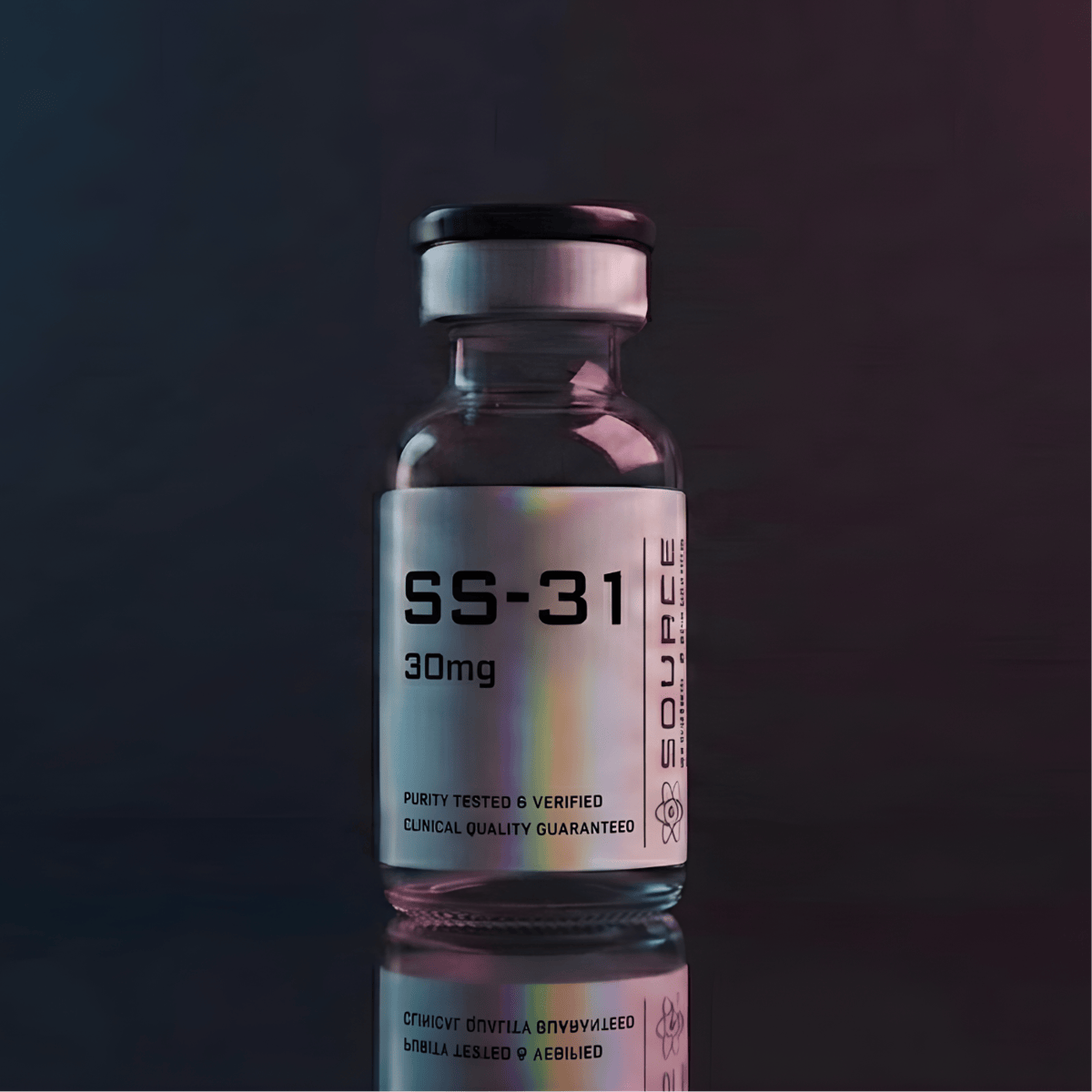
SS-31 (Elamipretide): The Structural Half of the Mitochondrial Story
You don't have an energy supply problem. The structure handling your energy has meteor-sized holes in it. And almost every intervention in this space — more NAD+, more creatine, more fuel — addresses the first problem while ignoring the second.
SS-31 is the exception. It's a four-amino-acid peptide that doesn't add fuel, doesn't stimulate anything, and doesn't supply a missing input. It restores the physical foundation that makes efficient energy production possible in the first place. That's a fundamentally different mechanism than most compounds you'll read about, and it's why the research keeps pointing to SS-31 in contexts where the primary problem is structural mitochondrial failure, not a shortage of raw material.
This is the full picture: what it is, what it does, what the research actually shows, and where it fits. If you want the other half of the story — the signal rather than the structure — read the MOTS-c article next.
What SS-31 Actually Is
SS-31 is the research designation. The generic name is elamipretide. It's a synthetic tetrapeptide with the sequence D-Arg-dimethylTyr-Lys-Phe-NH2 — four amino acids, alternating aromatic and basic, with a couple of deliberate modifications that let it slip across cell membranes and the mitochondrial membrane without needing a transporter. Molecular formula C32H49N9O5, molecular weight 639.8 g/mol, CAS 736992-21-5.
It was engineered by Hazel Szeto and Peter Schiller as the lead compound in a series of mitochondria-targeted peptides. The "SS" is their initials. The design goal was specific: a molecule that concentrates at the inner mitochondrial membrane and stays there, rather than distributing everywhere the way a conventional antioxidant does.
That targeting is the whole point. Clinical-grade SS-31 at Source BioLab is elamipretide — the same tetrapeptide, unmodified.
Your Mitochondria Are Drowning in Their Own Exhaust
Inside every one of the roughly 37 trillion cells in your body, your mitochondria (the powerhouse of the cell) run a tightly organized assembly line called the electron transport chain. Think of it as the factory floor that manufactures ATP — the currency your body uses to do essentially everything. That factory floor depends on a phospholipid (a fat molecule that forms cell membranes) called cardiolipin to hold the structural proteins in the right positions. Cardiolipin is unusual: it's found almost exclusively in the inner mitochondrial membrane, it has four fatty-acid tails instead of the usual two, and it's the foundation the respiratory complexes (the protein machinery that makes energy) are anchored to — the reason electrons can move through them efficiently.
When cardiolipin gets damaged by oxidative stress — cellular exhaust, essentially — those proteins shift. The foundation cracks. Energy output drops. Damaged byproducts accumulate. And from there, everything downstream starts to degrade. Worse, damaged cardiolipin becomes a signal in its own right: it migrates to the outer membrane and flags the cell for programmed death.
Before you write off oxidative stress as something you don't understand and that probably doesn't apply to you, let me paint the picture.
- Did you drink enough water today?
- Did you eat enough real food, with the full spread of micronutrients and vitamins?
- Have a drink — or five — this weekend?
- The 8 hours of sleep you need — cut that short a couple of times?
Ok, cool. Now understand that saying yes to any one of those, without loading up on antioxidants, is more than likely raising your oxidative stress load and contributing to this exact problem. Those casual hits of the vape? They're ruining your biology more than you know. And the 400–500 mg of caffeine it takes to get through 8 hours of a desk job — yeah, that's the smoke from a building that's on fire.
SS-31 binds cardiolipin. Specifically, the positively charged residues in the peptide interact with the negatively charged head groups of cardiolipin, stabilizing its structure and protecting it from oxidative damage. The measurable consequences in the lab are consistent across studies: mitochondrial membrane potential (the electrical charge across the membrane that drives energy production) holds up, reactive oxygen species (cellular exhaust) drop, the oxidative-phosphorylation proteins (the machinery that makes ATP) stay intact, and the cell gets more ATP out of every unit of oxygen.
At the core, this isn't a raw-material problem that gets solved by supplying more. It's a structural deficit. Cracks in the foundation. SS-31 helps fill those cracks, secures your body's energy-system foundation, and lets you build on top of it. This is the ground floor — arguably the most important.
What the 2026 Research Added
Three preclinical studies this year gave a sharper picture — rodent models and cell lines, no new human trial data, and worth holding that distinction the whole way through.
Spinal cord injury. A study in Neurochemistry International (Song et al., DOI 10.1016/j.neuint.2026.106171) used a mouse contusion model and found SS-31 significantly improved locomotor recovery and gait. Histologically, less lesion pathology and more neurons preserved. What's interesting is the timeline: early after injury, SS-31 reduced apoptosis (programmed cell death) signaling. In the chronic phase, it did something different — reduced astrogliosis (scar-forming activity by the brain's support cells), and more of the markers that show nerve fibers and connections rebuilding. Same compound, two jobs, depending on where you are in the injury sequence.
Lung injury. A study in the International Journal of Molecular Sciences (Lu et al., DOI 10.3390/ijms27083357) looked at a newborn hyperoxia (high-oxygen lung injury) model and identified a potential interaction between SS-31 and an inner-membrane iron-transport protein. SS-31 preserved that protein's levels and mitigated the structural simplification of lung tissue that hyperoxia causes. For your science nerds out there — if this holds up, it suggests SS-31's reach inside the mitochondria is broader than the canonical cardiolipin mechanism alone.
Sepsis-associated encephalopathy. A review in Frontiers in Neuroscience (Shen et al., DOI 10.3389/fnins.2026.1824178) positioned SS-31 as a candidate for the mitochondrial-dysfunction–neuroinflammation axis in SAE (sepsis-associated encephalopathy — brain dysfunction caused by severe infection), alongside next-generation interventions like mitochondrial transplantation. Not a fringe compound. A measuring stick the field benchmarks against.
Here's the kicker: potential interaction means hypothesis, not confirmed mechanism. And preclinical means there's no human dosing protocol from this data. These studies tell us where to look and why the mechanism is coherent. They don't hand us a clinical playbook.
What Makes SS-31 Different From Most of This Space
Unlike most compounds you'll read about here, elamipretide has been through actual human clinical trials — as a drug candidate, under its generic name, for rare mitochondrial diseases. That's a meaningfully different evidence base than "promising in mice."
The human trials have been in rare conditions like Barth syndrome (a genetic cardiolipin disorder — which tells you how directly the mechanism maps) and primary mitochondrial myopathy (a muscle disease caused by failing mitochondria). The results have been mixed: signals in some endpoints, misses in others, and the regulatory path has been long. Two things follow from that. First, it means the safety profile in humans has been characterized in a way most research peptides never are. Second, it means the effect size in humans, even in the populations where the mechanism is most directly relevant, is not dramatic. Anyone telling you SS-31 is a transformative compound is selling something the trial data doesn't support.
What the trial history does support: the mechanism is real, it translates to humans, the compound is tolerated, and the benefit is most plausible where structural mitochondrial failure is the primary problem.
SS-31 vs. the Other Mitochondrial Tools
| Compound | What it is | Where it acts | What it does | Human trial data |
|---|---|---|---|---|
| SS-31 (Elamipretide) | 4-aa synthetic tetrapeptide | Inner mitochondrial membrane (cardiolipin) | Restores the membrane foundation energy production sits on | Yes — clinical trials in mitochondrial disease |
| MOTS-c | 16-aa mitochondrial-encoded peptide | Nucleus, AMPK, lysosome, fibroblasts | Signals adaptation under metabolic stress | Observational only (endogenous levels) |
| NAD+ precursors (NMN, NR) | Coenzyme building blocks | Cytoplasm and mitochondria | Supply raw material for energy metabolism | Yes — supplement trials, mixed results |
| CoQ10 / MitoQ | Electron carrier and a mitochondria-targeted version | Electron transport chain | Antioxidant and electron shuttle | Yes — mixed |
The framing: SS-31 is the mechanic. It gets under the hood and repairs the structure of the engine. MOTS-c is closer to the fuel — a signal that tells a working engine how to perform under load. NAD+ is raw material. If you're driving a Prius, it doesn't matter what fuel you put in — you're limited by the vehicle. Fix the engine first, and suddenly fuel quality matters.
The Practical Takeaway
Most people approach cellular optimization as a fuel problem. More NAD+. More creatine. More fuel. But if the mitochondrial infrastructure itself is compromised — if the foundation is cracked — adding more inputs doesn't fix the machine.
SS-31's research trajectory says the structure of energy production matters as much as the raw materials feeding it. That has implications well beyond acute injury or disease, because the same mitochondrial failure modes showing up in spinal cord injury research — membrane collapse, ROS accumulation, impaired energy output — are the same ones implicated in age-related cognitive decline, muscle loss, and tissue degeneration. The timeline is slower. The mechanism is the same.
The dual-phase finding — anti-apoptotic acutely, pro-regenerative later — suggests timing may matter more than most protocols currently account for. We don't yet know how that translates to human application, but it changes how a thoughtful clinician should think about when an intervention is introduced, not just whether it's introduced.
Before any of this becomes relevant to you personally — SS-31 is not a foundation. Sleep, inflammation, bloodwork, movement come first. A mitochondrial repair compound working inside a system that's being constantly hammered by upstream inputs you haven't addressed is signal with nowhere to land. Get the sequence right, and tools like this become genuinely compelling. Get it backwards, and you're wasting the opportunity.
Who This Is and Isn't For
*Worth understanding closely if:*
- The foundation is built and you're working on recovery, resilience, or longevity mechanisms
- Your interest is specifically mitochondrial — fatigue that doesn't track with sleep or training load, recovery that's slowed with age, or the structural side of cellular aging
- You want a compound with an actual human safety record rather than only animal data
- You're pairing it with the signaling side and want the full picture
*Not the right conversation if:*
- You want a performance or fat-loss effect. Nothing in the trial record supports that.
- You haven't measured your inflammatory and metabolic baseline. You'd be reconstructing an engine you haven't inspected.
- The basics aren't in place. Paper planes into a burning building.
Frequently Asked Questions
Is SS-31 the same as elamipretide? Yes. SS-31 is the research designation; elamipretide is the generic drug name. Same tetrapeptide.
Is it FDA-approved? Not as of this writing. It has been evaluated in FDA-regulated clinical trials for rare mitochondrial diseases, which is more human evidence than nearly any other research peptide has, but it does not carry an approval for any indication. Source BioLab supplies clinical-grade SS-31 for research use only.
Is there a human dosing protocol? There are published trial doses in specific disease populations under medical supervision. There is no established protocol for healthy adults, and the 2026 preclinical work does not produce one.
How is SS-31 different from a regular antioxidant? A conventional antioxidant distributes throughout the cell and scavenges whatever it encounters. SS-31 concentrates at the inner mitochondrial membrane and stabilizes cardiolipin specifically — it addresses where the damage originates rather than mopping up afterward. That's the difference between a targeted repair and a general one.
Should SS-31 be paired with MOTS-c? They address two halves of one problem — structure and signal — which is why they're so often discussed together. Whether that's the right pairing for you is a clinical question, not a general one, and it starts with a panel.
Does it build muscle? No. Peptides don't build muscle. SS-31's relevance to muscle is about mitochondrial function in muscle tissue, which is a different thing.
Related Reading
- MOTS-c: The Mitochondrial Signal
- Tesamorelin: The FDA-Approved GHRH Analog
- NAD+ and Cellular Energy Metabolism
- Peptide Reconstitution Calculator
- Book an Initial Protocol Call — $250, credited toward your first order
This content does not constitute medical advice, and is for educational purposes only. SS-31 is not approved for human therapeutic use. Products are supplied for research use only.