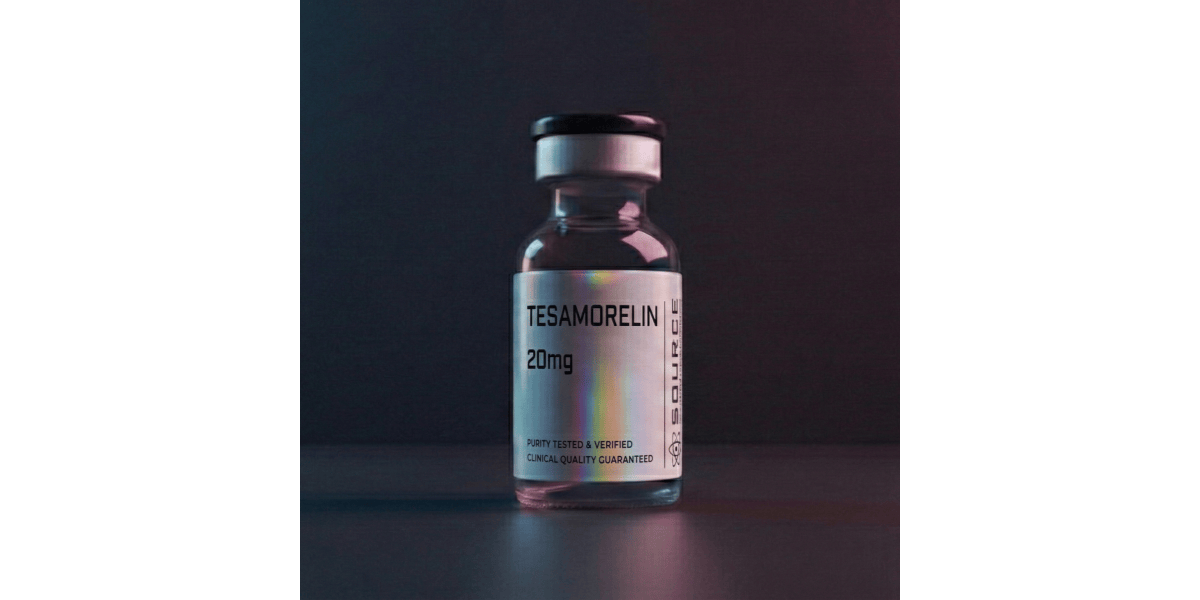
Tesamorelin: The FDA-Approved GHRH Analog — What the Trials Actually Showed
Most of the compounds discussed in this space share one uncomfortable fact: the human evidence is thin. Promising in mice, interesting in cell lines, and then a long silence where the clinical trials should be.
Tesamorelin is the exception in the growth-hormone conversation. It has two randomized, placebo-controlled Phase 3 trials, a pooled analysis covering more than 800 people, a New England Journal of Medicine publication, and an FDA approval that's been on the books since 2010. When a 2026 review in Sports Medicine catalogued the peptides people are actually using and sorted them by evidence, tesamorelin was the one it held up as the comparator with robust human data.
That makes it worth understanding properly — including what the approval does and doesn't cover, and why the honest version of this story is more useful than the hype version.
What Tesamorelin Actually Is
Tesamorelin is a synthetic analog of human growth-hormone-releasing hormone — GHRH — the hypothalamic (from the brain's hormone-control center) peptide that tells your pituitary to release growth hormone. It was developed under the code TH9507 by Theratechnologies in Montreal.
The design problem it solved is simple. Native GHRH circulates for only minutes, because an enzyme called dipeptidyl peptidase-4 (DPP-4, the same enzyme some diabetes drugs block) clips its first two amino acids and inactivates it. Tesamorelin keeps the complete 44-amino-acid sequence of human GHRH and adds a trans-3-hexenoyl group to the N-terminal tyrosine. That single modification blocks the cleavage without changing the part of the molecule that binds the receptor. The result is a molecule stable enough for once-daily subcutaneous administration in the trials that followed.
For the chemistry-minded: molecular formula C221H366N72O67S, molecular weight about 5,136 g/mol, CAS 218949-48-5. Clinical-grade tesamorelin at Source BioLab is that molecule.
How It Works — and Why "Upstream" Matters
Tesamorelin binds the GHRH receptor on pituitary somatotrophs (the cells that make growth hormone). That receptor is Gs-coupled (a switch that raises a second messenger inside the cell): binding raises intracellular cyclic AMP, and the cell responds by releasing growth hormone in a pulse. Growth hormone then drives the liver to produce IGF-1 (insulin-like growth factor 1, the hormone that carries most of growth hormone's downstream effects).
The word that matters here is pulse. Your body doesn't secrete growth hormone at a steady level — it releases it in bursts, mostly at night, under the control of GHRH pushing up and somatostatin (the brake hormone) pushing down. Tesamorelin works at the top of that system rather than the bottom. It doesn't put growth hormone into you. It asks the pituitary to release what it's capable of releasing, and the pituitary still answers to its own feedback — somatostatin and IGF-1 can still turn it down.
This is the whole distinction between a GHRH analog and injecting growth hormone directly. Exogenous GH bypasses every regulatory checkpoint your body has. A GHRH analog keeps them. That's a meaningfully different safety conversation, and it's part of why tesamorelin has the trial history it has.
Reported elimination half-life after subcutaneous administration is about 26 minutes. That's short — the molecule clears quickly, and its effect is on the pulse it triggers, not on sustained circulating levels.
What the Trials Showed
The pivotal Phase 3 trial, reported by Falutz et al. in the New England Journal of Medicine (2007;357:2359-2366), randomized 412 people with HIV and excess abdominal fat to tesamorelin 2 mg once daily or placebo for 26 weeks. Visceral adipose tissue (the deep fat packed around the organs), measured by CT, fell 15.2 percent in the tesamorelin arm and rose 5.0 percent under placebo. A second identically designed Phase 3 trial replicated the result. A pooled analysis with open-label extension data (Falutz et al., Journal of Acquired Immune Deficiency Syndromes, 2010;53:311-322) covered 806 participants.
Two things are worth taking from those numbers.
First, the effect is specifically on visceral fat — the metabolically active fat around the organs — not subcutaneous fat, and not body weight in any dramatic way. This is the fat that matters for metabolic risk, and it's the fat that's hardest to move.
Second, the effect reversed when treatment stopped. Visceral fat came back over the following months in the discontinuation arms. That tells you tesamorelin is acting on a regulatory axis, not producing a permanent change. Nothing in the data supports the idea that a course of tesamorelin resets anything.
A later trial (Stanley et al., Lancet HIV, 2019) evaluated tesamorelin over 12 months in 61 people with HIV and non-alcoholic fatty liver disease (fat accumulating in the liver without heavy drinking), with biopsy-based assessment of liver fat and fibrosis progression. The signal on hepatic fat was consistent with the visceral-fat findings. Liver fat is one of the more consequential places visceral adiposity shows up, and this is one of the few peptide studies in this space with actual liver biopsies in it.
What the FDA Approval Actually Covers
On November 10, 2010, the FDA approved tesamorelin under the brand name Egrifta for the reduction of excess visceral abdominal fat in HIV-infected patients with lipodystrophy (an abnormal redistribution of body fat, in this case caused by HIV medications). It was the first agent approved for that indication. Reformulations followed as Egrifta SV in 2019 and Egrifta WR in 2025.
Read the indication carefully. It is confined to HIV-associated lipodystrophy. It does not extend to weight reduction or obesity in the general population. When you see "the only FDA-approved peptide for visceral fat reduction," that's technically true and materially incomplete — the approval is for a specific patient population with a specific drug-induced fat redistribution problem.
What the approval does establish, and this is why it matters for everyone else: the compound has been through the full safety characterization that approval requires. The adverse-event profile is documented. The interaction with the GH/IGF-1 axis has been measured in hundreds of people over months. That's not nothing. It's more than almost any other peptide in this category can say.
The 2026 Cardiac Signal
The most pharmacologically specific tesamorelin study published in 2026 came from an unexpected direction. Chege et al. (Brazilian Journal of Medical and Biological Research, 2026;59:e14744) ran a 24-week rat study looking at cardiac effects of HIV antiretroviral therapy under different diets. The antiretroviral regimens produced measurable ECG abnormalities and myocardial fibrosis. Co-administering tesamorelin prevented those cardiac effects.
The authors attributed the protection to restoration of the growth-hormone axis, which the antiretrovirals appear to disrupt. It's a rodent model, the diets were experimental constructs, and the mechanism wasn't isolated — so this is hypothesis-generating, not practice-changing. But it points at something the visceral-fat trials didn't measure: a cardioprotective dimension that may operate independently of body composition. If that holds up in humans, it would matter for a lot of people beyond the HIV population.
Tesamorelin vs. the Other GH-Axis Compounds
People group all of these under "growth hormone peptides." They are not interchangeable.
| Compound | Class | Where it acts | Duration | Human trial data |
|---|---|---|---|---|
| Tesamorelin | Full-length GHRH analog (44 aa, protease-resistant) | GHRH receptor, pituitary | Short half-life, once-daily | Yes — Phase 3, FDA-approved indication |
| Sermorelin | Truncated GHRH fragment (29 aa) | GHRH receptor, pituitary | Very short | Limited; formerly approved, withdrawn from market |
| CJC-1295 | Modified GHRH fragment engineered for prolonged circulation | GHRH receptor | Extended (with DAC) | Minimal |
| Ipamorelin | Ghrelin mimetic (GHS-R1a agonist) | Different receptor entirely | Short | Minimal |
| Recombinant GH | Exogenous growth hormone | Bypasses the pituitary | Sustained | Extensive — but a different risk profile |
Tesamorelin and sermorelin both act on the GHRH receptor, but tesamorelin keeps the complete native sequence with protease resistance, while sermorelin is only the first 29 residues and clears quickly. CJC-1295 is a modified fragment built for long circulation. Ipamorelin and GHRP-6 are a different class altogether — ghrelin mimetics (they imitate ghrelin, the hunger hormone) acting at the growth-hormone secretagogue receptor, which is why they're often paired with a GHRH analog: two different inputs to the same pulse. Source BioLab carries that pairing as Tesamorelin + Ipamorelin.
The Practical Takeaway
Tesamorelin's value isn't that it's a fat-loss compound. It's that it's the best-characterized tool for asking a specific question: what happens when you restore GHRH signaling in someone whose GH axis has drifted down?
Growth hormone pulses decline with age — that's well documented, and it tracks with the visceral-fat accumulation, the slower recovery, and the sleep-architecture changes people start noticing in their forties. A GHRH analog is the most conservative way to probe that, because it works upstream and keeps the body's own regulation in the loop.
But it's a probe, not a fix. The visceral-fat effect reverses on discontinuation. The approval is for a specific population. And the honest reading of the trial data is a real but modest effect in people who had a real deficit to correct.
Which is the whole point. Before this is relevant to you, you need to know whether there's a deficit to correct — and that means being honest with yourself about your routine, the holes in it, and whether it matches your bloodwork, not just how you feel. IGF-1, fasting glucose and insulin, a lipid panel, and a liver panel are the minimum. If you haven't looked at those in the last year, start there. A GHRH analog layered on top of an axis that's already working normally is a signal with nowhere to land.
Who This Is and Isn't For
*Worth understanding closely if:*
- You've measured your IGF-1 and metabolic markers and there's a documented reason to look at the GH axis
- Your concern is specifically visceral adiposity or liver fat — the metabolically consequential kind — rather than weight in general
- You want the compound in this category with an actual human trial record and a documented safety profile
- You understand this is a regulatory input, not a permanent change
*Not the right conversation if:*
- You're looking for general weight loss. The trials didn't show it, and the approval doesn't cover it.
- You want muscle. GHRH analogs don't build muscle — training and anabolic signaling do.
- You haven't measured your baseline. There's no way to know if the axis needs input, and you'd be optimizing blind.
- Consistent daily injection is a hard no. This is a once-daily compound with a 26-minute half-life; it doesn't work any other way.
Frequently Asked Questions
Is tesamorelin FDA-approved? Yes — as Egrifta, since 2010, for reduction of excess visceral abdominal fat in HIV-infected patients with lipodystrophy. That is the only approved indication. Source BioLab supplies clinical-grade tesamorelin for research use only.
Is it the same as growth hormone? No. Tesamorelin is a GHRH analog — it signals the pituitary to release your own growth hormone in a pulse. Exogenous GH bypasses the pituitary entirely. The safety and regulatory conversations are different.
Does the visceral-fat effect last? Not without continued administration. In the trial discontinuation arms, visceral fat returned over the following months.
How is it different from sermorelin? Sermorelin is the first 29 amino acids of GHRH; tesamorelin is the full 44 with a modification that resists enzymatic breakdown. Tesamorelin has Phase 3 trial data and an active FDA approval; sermorelin's approval was withdrawn.
Why is it paired with ipamorelin? Ipamorelin works at a different receptor — the ghrelin receptor — so the two provide independent inputs to the same growth-hormone pulse. It's a common research pairing for that reason.
What was the trial dose? The Phase 3 trials used 2 mg subcutaneously once daily in HIV-associated lipodystrophy under medical supervision. That's the published research dose in a specific patient population; it is not a general protocol.
Related Reading
- MOTS-c: The Mitochondrial Signal
- SS-31 (Elamipretide): The Structural Half of the Mitochondrial Story
- Tesamorelin + Ipamorelin
- Peptide Reconstitution Calculator
- Book an Initial Protocol Call — $250, credited toward your first order
This content does not constitute medical advice, and is for educational purposes only. Tesamorelin is FDA-approved only for HIV-associated lipodystrophy. Products are supplied for research use only.